
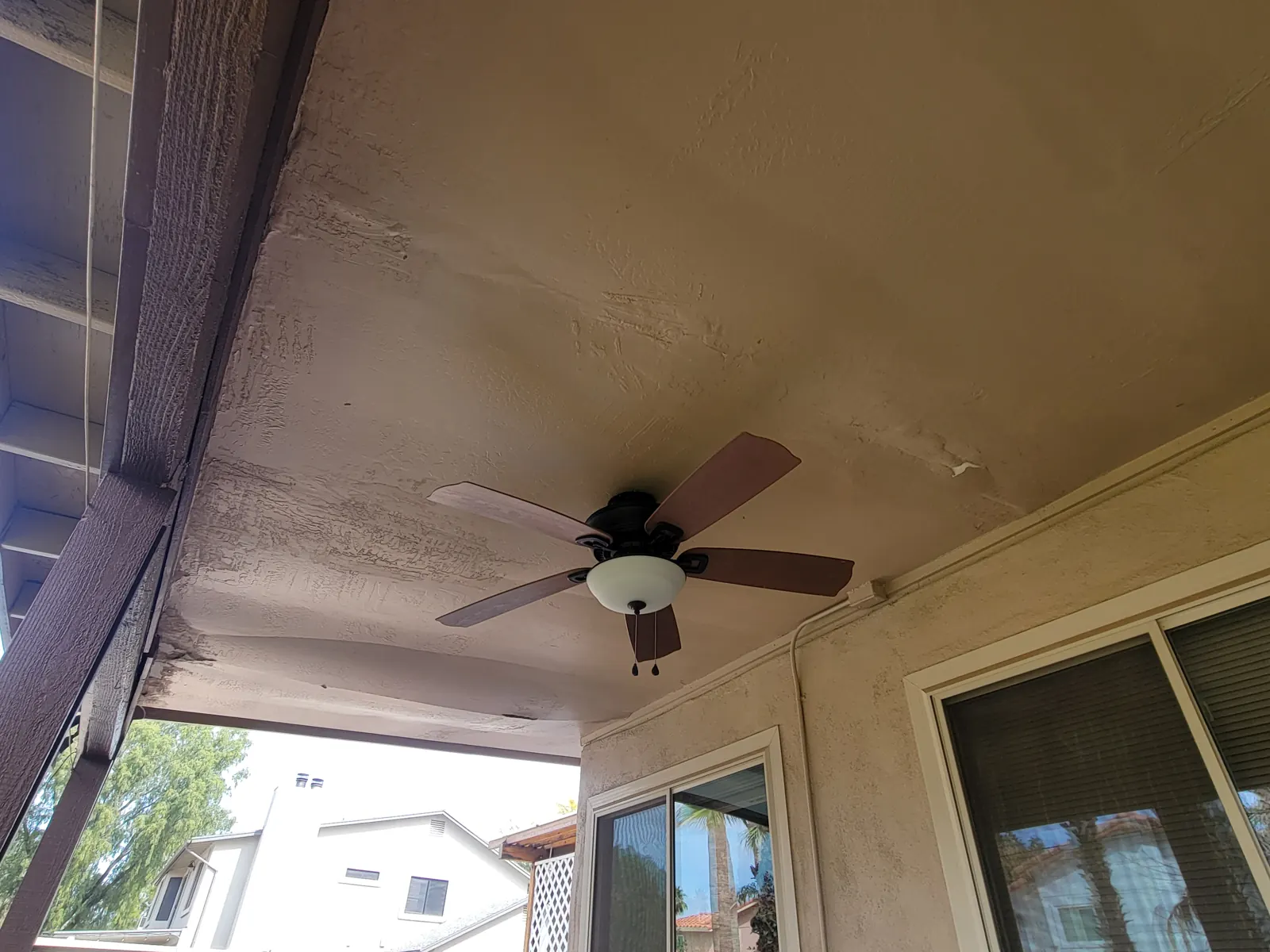
The Textures You Will Find in Valley Homes
Orange peel is the most common. It is a fine spray of thinned joint compound that dries into a surface that looks like the skin of an orange, and it is on the walls of most production homes built since the 1980s. Knockdown starts the same way but is flattened with a wide knife while wet, leaving a mottled, flattened pattern. Ceilings in older homes often have a heavier spray texture, and some have the acoustic popcorn finish that was common through the 1980s.
Custom and older homes sometimes have hand-troweled textures, Santa Fe style skip trowel, or a sand finish. Each of these needs a different technique, and the same crew that is good at orange peel may struggle with skip trowel.
Knowing which one you have is the first step. A photo of the wall in raking light, with a coin in the frame for scale, tells us most of what we need.
Why Patches Stand Out
A patch shows for three reasons: the surface is a different texture, the surface is a different sheen, or the surface is a different plane. All three have to be handled for the patch to disappear.
Texture is obvious. If the patch is smooth or has a texture sprayed at a different pressure or thinned differently, it reads as a different pattern. Sheen is subtle. Fresh paint over a patch, even the same color, reflects light differently from paint that has aged for ten years, and the patch shows as a dull or shiny rectangle at certain angles. Plane is the one most people miss. If the patch is slightly proud of the wall or slightly recessed, raking light from a window will catch the edge.
The paint stores sell texture in a spray can, and it works for very small spots. For anything bigger than a fist, the can texture rarely matches the pressure, droplet size and thickness of the original, which is why so many homes have a patch that is almost right.
- Different texture pattern or droplet size
- Different paint sheen or a visible paint edge
- Patch sits proud or recessed from the surrounding wall
- Texture feathered too tightly so the transition line shows
What a Proper Repair Involves
For a hole, the damaged section is cut back to clean edges and either backed with a patch plate or a new piece of drywall fitted to framing. Joint compound is applied in several thin coats, each sanded, until the patch is flush with the wall and the edges are feathered out well beyond the hole. This is where the plane problem is solved, and it is also where rushed work goes wrong.
Then the texture is matched. For orange peel and knockdown, that means a hopper gun or a texture sprayer, with the compound thinned to match the original droplet size and sprayed in a feathered pattern that blends into the existing texture over a wide area rather than stopping at the patch edge. For knockdown, the sprayed texture is allowed to set briefly and then flattened with a knife at the same timing the original crew used. For hand textures, it is done with a trowel and takes a practiced eye.
After the texture dries, the area is primed. Primer matters because bare compound absorbs paint differently from the painted wall around it, and skipping it is the main cause of the sheen problem. Then the paint is applied over a wider area than the patch, ideally the full wall from corner to corner, so there is no paint edge to catch light.
Why Painting the Whole Wall Matters
Even with a perfect color match, a spot of fresh paint on a wall that has aged in Arizona sun and air conditioning will often show. Paint fades, collects a film and changes sheen over years. Painting the whole wall, corner to corner, gives you one continuous surface with no transition. On a small accent wall this is quick. On a large great room wall it is more work, but it is the difference between a repair that disappears and one you notice every time you walk past.
If the paint on the wall is relatively new and you have the same can, a feathered touch-up can work. We will tell you honestly which situation you are in.
Ceilings Are Harder
Ceiling repairs after a roof leak, a plumbing leak or a fan replacement are the hardest to hide because ceilings get raking light from windows all day. Heavy ceiling textures from the 1980s and 1990s are also thicker and were applied with equipment that is not common now. A ceiling patch needs the texture built up to the right thickness and blended over a wide area.
Popcorn ceilings are a special case. Matching popcorn is possible with the right product, but homes built before the early 1980s can have asbestos in the popcorn material, and that should be tested before anyone sands or scrapes it. If a test comes back positive, the work is for an abatement company, not a handyman, and we will say so.
Water Stains and Repeated Cracks
A brown water stain on a ceiling is not just a paint problem. If the drywall is still solid, the stain needs a stain-blocking primer before paint or it will bleed through again. If the drywall is soft, crumbly or sagging, the section has to be cut out and replaced. Painting over soft drywall just delays a bigger repair.
Cracks that keep coming back at the same spot, usually above a door or at a ceiling corner, are moving with the house. Our guide on wall and ceiling cracks explains which ones are structural. For the cosmetic ones, the repair involves a flexible mesh tape and compound, then texture and paint, rather than just filling the crack again.
How to Judge the Work
Look at the repair in daylight from across the room, and then from the side with light raking across the wall. You should not be able to find the patch edges. Run your hand across it. It should feel like the surrounding wall, not smoother and not rougher. Look at the paint edge, if there is one; it should be at a corner, not in the middle of the wall.
A good drywall and texture repair is finished in two or three visits because of drying time between coats and texture, unless fast-setting products are used. Someone who promises to patch, texture and paint a large hole in an hour is not matching anything.
- No visible patch edges in raking light
- Texture feels and looks continuous
- Paint edge at a corner, not mid-wall
- Stains primed with a stain blocker before paint
- Soft or sagging drywall replaced, not painted over
“Nathan did an amazing job switching the closet door hinges on my master closet to maximize my space and the work looks great! Will definitely be using him again as he has a wide scope of expertise”