
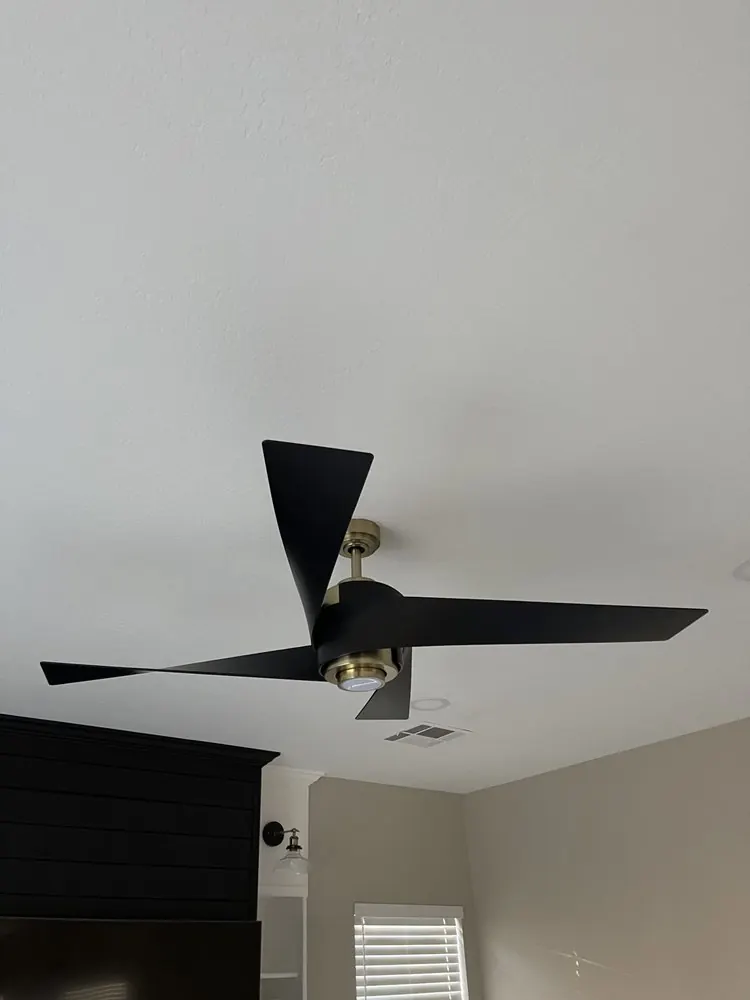
Why Fans Wobble
A fan that wobbles is either loose or unbalanced. Loose is far more common. Over years of running, the screws holding the blades to the blade arms and the arms to the motor loosen slightly, and the mounting bracket in the ceiling box can loosen too. Turning the fan off and tightening every screw you can reach fixes a surprising number of wobbles.
If every screw is tight and it still wobbles, one blade is out of plane with the others, often because it warped in attic heat or absorbed moisture. Measuring the distance from each blade tip to the ceiling shows which one is off. A balancing kit with a clip and adhesive weights takes care of small differences.
A wobble that comes with a clicking noise or a fan that visibly moves at the ceiling is a mounting problem and should be looked at before it gets worse. The fan should be hung from a box that is rated for fan support and screwed to framing, not a standard light box.
- Tighten blade screws, blade arm screws and the canopy
- Check that the ceiling box is fan-rated and solidly mounted
- Measure blade tips to the ceiling to find a warped blade
- Balance with a clip-on weight kit if the blades are even
The Ceiling Box Problem in Older Valley Homes
Many homes in Sun City, Glendale and older parts of Peoria were built with a standard light box in the bedrooms, and a fan was added later. A standard box is not designed to carry a spinning load. The fan may have run fine for years, but the screws work loose, the box flexes, and the fan starts to wobble or sag.
The fix is to replace the box with a fan-rated box attached to the joist or to a brace that spans between joists. This is a common job for us and does not require opening a large section of ceiling. If you are replacing a fan anyway, ask for the box to be checked at the same time.
Fans that hang from a downrod on a vaulted ceiling put even more stress on the box and need a bracket designed for the angle.
Picking the Right Size
A fan that is too small for a room moves air only directly beneath it. Room size is the main factor. Small rooms and bathrooms do well with a fan under 44 inches. Standard bedrooms and offices are usually 44 to 52 inches. Living rooms, great rooms and large primary bedrooms do better with 52 to 60 inches or larger. The fan should hang so the blades are at least seven feet above the floor and about eight to nine feet is ideal, which on a tall ceiling means a downrod.
In a Valley home with a vaulted great room, one large fan on a long downrod usually works better than two small ones. The large slow-moving blades move more air with less noise.
Blade count and style matter less than diameter and motor quality. A three-blade fan with a good motor outperforms a five-blade fan with a cheap one.
Which Direction to Run It
Standing beneath the fan in summer, the blades should turn counterclockwise, pushing air down so you feel a breeze. The breeze does not lower the room temperature, it makes you feel cooler, so the fan only helps when someone is in the room. Turning it off when you leave saves electricity.
In the few cool weeks of a Valley winter, reversing the fan to clockwise on low pulls air up and pushes the warm air at the ceiling back down the walls. Most fans have a small switch on the motor housing for this, and some remote-control fans have a reverse button.
Because summer dominates here, many homeowners never switch and that is fine. The main thing is to make sure the fan is not accidentally running in reverse in July, which is a common reason a fan feels like it does nothing.
Noise, Speed and Light Kits
A hum that gets louder on low speed often comes from a cheap wall dimmer being used to control the fan. Fans need a fan-rated control or their own pull chain. A rattle is usually a loose light kit glass or a loose blade. A grinding or scraping sound from the motor is a bearing problem, and on an older fan that usually means replacement.
A fan that only works on one speed, or that the remote no longer controls, is often a failed capacitor or receiver. Those can be replaced on better fans, but on an inexpensive fan the parts and labor approach the cost of a new fan.
Light kits with old halogen or candelabra bulbs produce heat right under the fan. Swapping to LED bulbs or a newer integrated LED fan reduces heat and the frequency of bulb changes on a tall ceiling.
Outdoor and Patio Fans
A patio fan takes more abuse than any fan in the house. Dust, monsoon humidity and direct heat break down fans that are not rated for it. Indoor fans used on a covered patio rust at the blade arms, the blades sag and the motor fails early. A damp-rated or wet-rated fan with sealed motor and all-weather blades lasts years longer.
Patio ceilings in the Valley are often plywood with a thin finish, and the box behind them is sometimes nothing more than a plastic ring. If the patio fan wobbles or the ceiling around it has gone soft, the repair includes the ceiling. We do both together.
Repair or Replace
Tightening, balancing, a new ceiling box, a new capacitor or a new remote receiver are all reasonable repairs on a fan you like. A motor that grinds, a fan that has rusted or sagged, a fan with cracked blades, or one that is simply too small for the room is better replaced. New fans are quieter, move more air per watt and often include the light and remote.
Replacement is normally a one-visit job: remove the old fan, verify or replace the box, hang and wire the new fan, balance it and test every speed and the light. If you want it on a wall control instead of a pull chain, that is a small addition.
“We've had Nathan do several projects for us: installing a ceiling fan, changing out a vanity with a single sink to a dual, and changing a window into a sliding door and all of them were done very professionally with amazing attention to detail. I highly...”